
A Question to the Government of Independent Tatarstan in Exile: “Can Russians Work in Your Organization?”
Recently, a representative of the Russian people from Russia approached us with this question—and indeed, such people can join our work. To provide a complete picture of the interaction between Russians and the Tatar national movement in Tatarstan, I will cite several…
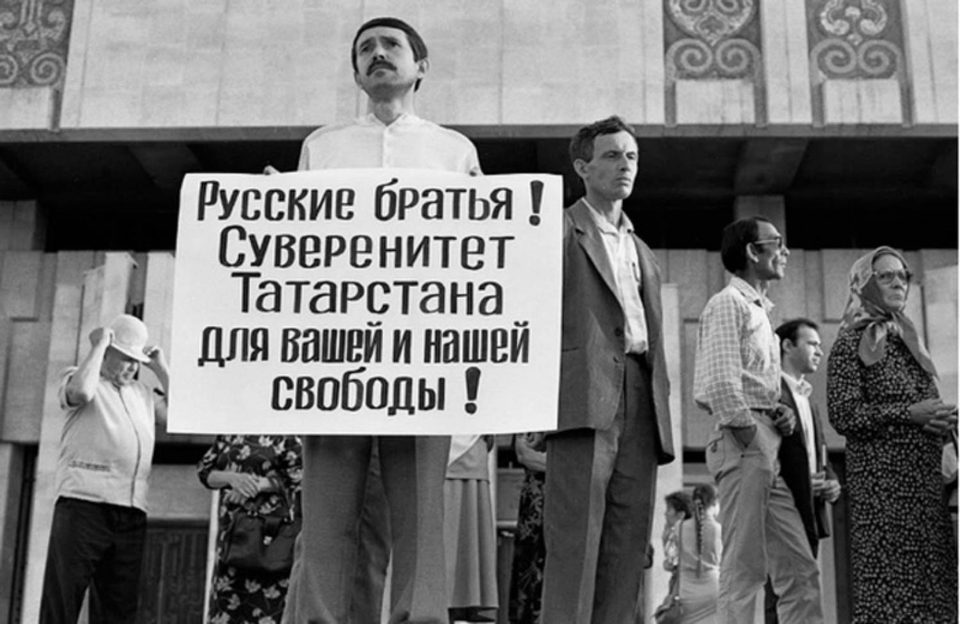
Back in the 1990s, when the TOC held citywide meetings in the concert hall named after Sary Sadykova in the Chelny City Hall building—where 600–800 people took part—Russians also participated in these meetings; I even remember one of the school principals, Russian by nationality, speaking from the podium in defense of the Tatar people.
For us, Tatars, a very important historical moment: at the 1992 referendum, 65% of Tatars and about 25% of Russians voted for Tatarstan’s independence. They understood perfectly well that Moscow was robbing the Republic of Tatarstan, and they hoped that all wealth—both underground and above ground—would work for the benefit of an independent republic. Indeed, these are our Russians.
I still remember how the First Russian–Chechen War unfolded: my twin brother Nafis Kashapov delivered humanitarian aid to Ichkeria. The authorities of Tatarstan then asked us to make sure that there was a special forces officer in each truck. During the trip, the special forces officers behaved very aggressively toward the Chechens. But when they saw with their own eyes what the Russian military was doing in Ichkeria, their attitude toward this war changed sharply. What does this say about the current situation in the Russian–Ukrainian war? If the whole truth about the atrocities of the Russian military becomes known, the attitude of many people in Russia toward Ukrainians will also change, but for now they still believe Putin’s television.
When I was chairman of the TOC, financial support was provided by private entrepreneurs and many enterprise directors, bankers, among whom there were quite a few Russians. This means that they clearly understood what we were striving for. By the way, some of these directors are still in their posts.
In those years, the Tatar national movement was actively joined by Zinnur Agliullin, Talgat Akhmadishin, Gayaz Malikhov, Nail Mansurov, Rifkat Kurmashev, Askar Khannanov, Gabdulla Sarvaretedinov, Farit Rakhimov, Gabdrakhman Zalyalutdinov and many others. I am very grateful to them; they made an enormous contribution to the struggle for the independence of the Republic of Tatarstan.
Returning to the beginning of the conversation, I will say that working on the PNT team in exile is very dangerous: in the last six months alone, three of our activists ended up in prison, and two were placed on a wanted list. There was even a case when an FSB agent infiltrated our group and posted phone numbers on Facebook in order to carry out repressive actions against us.
At present, we have three groups: the first is the officially recognized part of our collective using online voting; the second is the “old guard,” consisting of deputies, officials, and law enforcement officers who support Tatarstan’s independence; the third is for those who work underground. All of these groups include people of different nationalities. Each group has its own administrator. At present, there are seven Russians among us who work underground. Three of them know the Tatar language, as does Sergey Vishnyakov, who is currently in a Putin concentration camp. By the way, for many years we have worked fruitfully in Tatarstan with all organizations representing various peoples.
I wrote this letter as an instruction for those who want to fight with us for the independence of Tatarstan, including for those who, together with us, defend the colonized peoples of Muscovy.
Respectfully,
Rafis Kashapov — Prime Minister of the Government of Independent Tatarstan in Exile