
Sovereignty Swallowed: Who Got Tatarstan’s Assets
Thirty-six years ago Tatarstan was told to take as much sovereignty as it could swallow. It was taken — but not by the republic. Records, documents and questions that no independent institution in Tatarstan has answered.
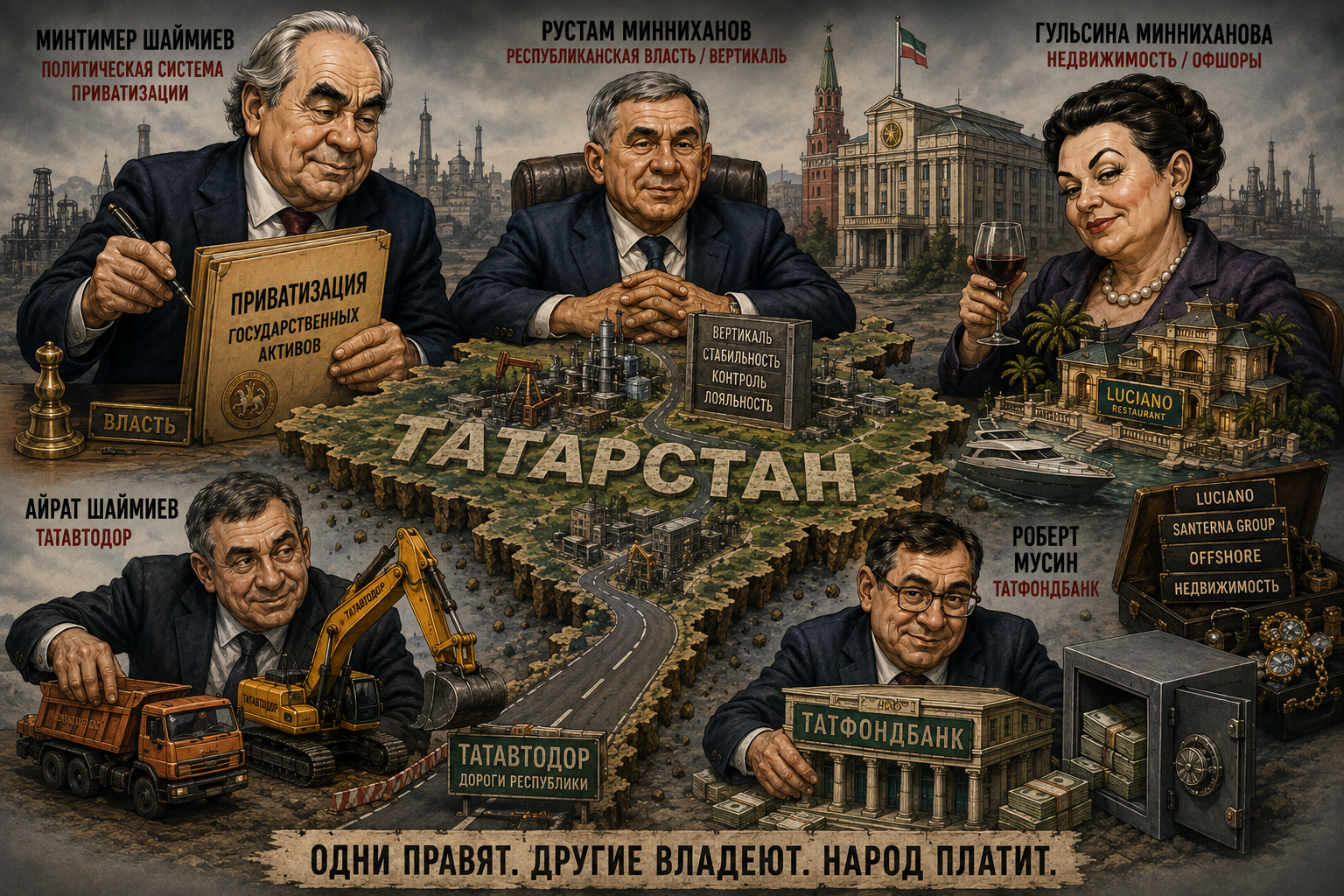
Materials of the Government of Independent Tatarstan in Exile
Every statement presented here as fact is based on open registries, declarations, court decisions, sanctions lists and reporting by Forbes, Kommersant, BUSINESS Online, Realnoe Vremya, Vedomosti, OCCRP, Important Stories, Idel.Realities and the Anti-Corruption Foundation. Where we cite someone else’s allegation or interpretation, we identify it as such and include the responses of those concerned. We are presenting an account, not a verdict: verdicts belong to courts, and Tatarstan will yet have a court worthy of that name.
Who actually did the swallowing
In the summer of 1990, Boris Yeltsin’s formula was heard in Kazan: take as much sovereignty as you can swallow. Thirty-six years later, the result is clear — and it is not the picture once painted in the squares.
Political autonomy ended in 2017 when the power-sharing treaty was not renewed, and it was further dismantled in 2023 when the title of president of the republic was replaced with rais. Economic self-government suffered one of its heaviest blows in 2021, when Tatarstan’s largest independent petrochemical complex passed to SIBUR.
But the crucial transformation happened between those dates. Plants built by the labor of generations became the private property of a narrow circle. The largest private fortunes arose in immediate proximity to the republic’s political leadership — above all around the family of the first president and its long-standing business partners.
This is not written merely to shock the reader. It goes to the substance of the independence question. Not a flag. Not an anthem. Ownership of Nizhnekamsk.
I. TAIF: how “ours” became “theirs”
The TAIF group grew out of the Kazan association created in 1990, at the height of debates about an independent course. The name stood for Tatar-American Investments and Finance and suggested a simple idea: from now on, we would manage our own affairs, without Moscow.
“Our own” turned out to be an accurate phrase. It simply did not refer to the republic.
By the late 2010s TAIF controlled more than sixty enterprises, including TAIF-NK, Kazanorgsintez, Nizhnekamskneftekhim, TGC-16, the Novy Vek broadcasting company, Avers Bank and businesses in construction and finance. It was one of Tatarstan’s largest industrial centers and its principal petrochemical complex.
The shareholder structure at the end of 2014 was disclosed in court materials and reported by Interfax:
| Shareholder | Stake | Who |
|---|---|---|
| Radik Shaimiev | 11.46% | son of Tatarstan’s first president |
| Airat Shaimiev | 11.45% | son of Tatarstan’s first president |
| Kamila Shaimieva | 2% | granddaughter of Tatarstan’s first president |
| Transport LLC | 19.9% | Albert and Timur Shigabutdinov, top management |
| AS LLC | 8.02% | Albert Shigabutdinov, top management |
| Guzelia Safina | 4.5% | TAIF deputy general director |
Forbes later estimated the brothers’ stakes at 19.5% each.
BUSINESS Online — a Kazan publication operating inside the republic and hardly known for radicalism — described the process plainly: Tatarstan’s petrochemical industry was privatized in the early 2000s in favor of the Shaimiev, Shigabutdinov and Sulteev families. Forbes later summarized the same transformation: a holding created as property of the republic became a private company belonging to the sons of Mintimer Shaimiev and two top managers.
Now look at the calendar. The assets moved into private hands while Mintimer Shaimiev was the serving president of Tatarstan, and his sons were among the recipients.
That leaves a question we ask directly because no independent institution has answered it publicly: on what terms and with what funds did the sons of the serving head of the region acquire stakes in an industrial group of state origin? There is no public answer. Not an unconvincing answer — no answer.
II. The 2021 deal: the republic lost, the families gained
In April 2021 it was announced that SIBUR, associated with Leonid Mikhelson and Gennady Timchenko, would take control of TAIF’s petrochemical and energy assets. By September the transaction had moved further: SIBUR would consolidate 100% of the relevant TAIF group. TAIF shareholders received 15% of the combined company, while financial obligations in the second stage were secured by bond issues; reporting put the bond component at about $3 billion. Forbes called it the deal of the year and valued the combined company at about $27 billion.
The public explanation sounded respectable. Albert Shigabutdinov said the previous rate of development was no longer sufficient for the companies to survive; Rustam Minnikhanov referred to the debt burden.
Perhaps so. But the outcomes for the republic and for the owners were strikingly different.
The republic lost the largest industrial complex that had remained under local control. Plants central to Nizhnekamsk and Kazan became part of a federal holding tied to figures close to Vladimir Putin.
The families converted a regional asset into shares in a federal holding and foreign-currency securities. BUSINESS Online reported that the combined wealth of four Tatarstan billionaires later rose to around $9 billion.
In the 2026 Russian Forbes ranking, four billionaires are identified with Tatarstan: Airat Shaimiev, ranked 74th and CEO of Tatavtodor; Rustem Sulteev, 81st; Radik Shaimiev, 84th and CEO of NIRA-Export; and Albert Shigabutdinov, 85th. Forbes’s global profiles put Airat Shaimiev at about $1.9 billion and Radik at about $1.8 billion.
We include losses as well as gains because accuracy matters. The point is the scale: fluctuations of hundreds of millions of dollars barely alter the owners’ status, while the underlying assets originated in the economic infrastructure of the republic.
The four richest representatives of Tatarstan in that ranking are two sons of the first president and two of their long-standing business partners.
III. Tatavtodor: a state company run by a billionaire
Airat Shaimiev’s position deserves separate attention.
He heads JSC Tatavtodor. Forbes notes a fact rarely discussed in Tatarstan: the company is state-owned; its shares belong to the Republic of Tatarstan through the Ministry of Land and Property Relations.
Read that again. A state road company is headed by a dollar billionaire whose father led the republic for two decades and remains a state adviser.
On 2 November 2022 the United Kingdom imposed sanctions on Airat Shaimiev, identifying him as CEO of the state-owned Tatavtodor and citing an estimated net worth of £902 million. Canada added both Airat and Radik Shaimiev to its sanctions list on 13 June 2025. Radik Shaimiev has also been subject to Ukrainian sanctions since October 2022.
Road construction is among the sectors most exposed to corruption risks in many jurisdictions. In Tatarstan it has been led for almost two decades by a member of the ruling family. No independent audit of the republic’s road procurement over that period has been publicly presented.
We are not claiming that contracts were distributed dishonestly; we do not possess the underlying procurement files. We are making a different point: the republic lacks an institution sufficiently independent and trusted to examine that question.
IV. Luciano: a transaction that demands an explanation
First, the facts that are not disputed
Gulsina Minnikhanova, wife of Tatarstan’s head, owned the Luciano group — a spa, hotel, restaurant, fitness club and business center in central Kazan.
In 2016 she sold 49% of Luciano LLC to the Cyprus-registered Santerna Holdings Limited for 2.2 billion rubles. The head of the republic’s press service confirmed the transaction and said it was intended to raise funds for new business development. Minnikhanova retained a controlling 51% stake.
Her declared income for 2016 was 2.35 billion rubles. In 2017 she entered Forbes Russia’s ranking of the country’s 50 wealthiest women, in 23rd place, with assets estimated at $100 million. For scale, that amount exceeded Nizhnekamsk’s annual municipal budget at the time.
Vademecum reported in May 2017 that Santerna Holdings belonged to Noelia Holdings Limited in the British Virgin Islands and that the ultimate beneficiary was not publicly identified. Realnoe Vremya had earlier reported management through another BVI structure, Fastlimit Services Limited.
The Anti-Corruption Foundation’s version
In September 2020, shortly before the election for head of Tatarstan, the Anti-Corruption Foundation published an investigation into the business and property interests of the Minnikhanov family.
According to the Foundation, Ruben Vardanyan, founder of Troika Dialog, stood behind Santerna. Investigators examined the offshore company’s accounts and said that shortly after the purchase the stake was impaired to roughly one-fifth of its acquisition value: of $43.4 million, $38.4 million was written off or impaired.
The Foundation argued that such a loss made little commercial sense if the payment was solely for the asset, and characterized the transaction as a bribe to the family of Tatarstan’s leader of roughly 3 billion rubles.
The same investigation said Luciano LLC owned the buildings, while revenue was collected by another company, Service Center LLC, linked to Venera Gafarova, Gulsina Minnikhanova’s sister.
The response
Ruben Vardanyan publicly rejected the Foundation’s conclusions. In comments to Forbes he called the bribery allegation nonsense and said Luciano was a normal operating business and a joint project he had been developing for years and was satisfied with.
His position is part of the record. So are the offshore accounts cited by investigators. Readers can compare them themselves.
What happened next
On 26 January 2023 the U.S. Treasury sanctioned Rustam Minnikhanov, Gulsina Minnikhanova and Luciano. Treasury’s own notice referred to allegations by a Russian NGO concerning investments in Luciano while making clear that the sanctions designation rested on the legal authorities stated in the notice.
Luciano LLC was liquidated on 25 September 2025. Separately, from 28 February 2025 Gulsina Minnikhanova is listed in the Russian corporate register as founder of UK Luciano LLC, a different legal entity.
At this point the open data run out. Public sources do not establish how Santerna’s former 49% interest was settled or what happened to the economic interests of its beneficiaries. We do not know, and we say so plainly.
That uncertainty is itself relevant. In a transparent system, the chain of ownership and disposition of such a major transaction should be capable of independent verification. Nine years later, this one remains unclear in public data.
V. Property: this is where we have to be boring
Foreign property is precisely the area where inaccuracies can discredit an entire investigation, so the record matters.
In May 2022 OCCRP, Important Stories and dozens of partner outlets published Dubai Uncovered, based on a leaked Dubai property dataset. It identified Gulsina Minnikhanova as associated with an apartment in Tanzanite South 3 on Palm Jumeirah, valued at roughly $880,000.
There is an important correction. Important Stories later acknowledged that the UAE apartment had appeared in Rustam Minnikhanov’s declarations through 2019. The original claim that it had not been declared was wrong, and the newsroom apologized.
The apartment’s origin is also known and tragic. In 2013 the Minnikhanovs’ elder son Irek died in the Kazan air disaster. Kommersant, citing declarations, reported that Gulsina Minnikhanova inherited from him an apartment in the UAE and two parking spaces.
So we state this directly: the Dubai apartment is not evidence of a concealed asset. It was inherited and it was declared.
The broader property picture is a separate issue. In 2020 the Anti-Corruption Foundation estimated property it had identified in connection with the family at around 3.5 billion rubles, including houses in and around Kazan and apartments in Moscow and abroad. The investigation also discussed a floating helipad adjacent to one residence and described it as having been transferred to Tatarstan by Tatneft. The Proekt database on nepotism has also mapped property held through family companies and relatives.
VI. Tatfondbank: the bill went to depositors
While elite fortunes were being built around republican assets, residents of Tatarstan faced a much more direct loss.
Tatfondbank was among Russia’s fifty largest banks. Its board chairman and principal beneficiary was Robert Musin, a former Tatarstan finance minister and United Russia deputy. From August 2014 until the bank lost its license, its board of directors was chaired by the serving prime minister of Tatarstan, Ildar Khalikov.
That fact makes it difficult to portray the bank simply as a private institution detached from the republic’s authorities.
Estimates of the public stake differed depending on what was counted. In 2016 Tatfondbank itself reported that the share directly and indirectly belonging to the state had risen to 45.3%. Other publications gave lower figures based on narrower definitions. Khalikov later referred to the ministry’s direct stake of 11.5% when he joined the board. The differences illustrate how complicated the ownership chain had become.
In December 2016 the bank began restricting withdrawals. On 3 March 2017 the Central Bank revoked its license; Musin was detained the same day. Tatfondbank was declared bankrupt in April. Intekhbank and TFB-Finance also collapsed. The temporary administration later reported a negative capital position of tens of billions of rubles, with estimates of the balance-sheet hole exceeding 100 billion rubles. Regulators and insolvency administrators described a captive lending model in which a very large share of the loan book was connected to businesses associated with owners.
Deposit insurance covered individuals up to 1.4 million rubles. Claims above that amount entered bankruptcy proceedings and creditors recovered only part of what they were owed. Businesses, public-sector entities and small companies also lost billions. Depositors and creditors held repeated protests.
The criminal proceedings continued for years.
In September 2021 a Kazan district court sentenced Musin to 12 years for six counts of abuse of authority and stripped him of state honors. In November 2024 a second judgment led to an aggregate sentence of 12.5 years; the case involved alleged losses of around 26 billion rubles, while the court ordered 8.7 billion rubles to be recovered for the Deposit Insurance Agency.
On 11 June 2025 the same district court released Musin from punishment on medical grounds. Prosecutors objected. On 12 August 2025 the Supreme Court of Tatarstan overturned that release, although Musin was not returned to custody. In March 2026 another medical examination again confirmed a qualifying illness and the district court again ordered his release. On 24 April 2026 the republic’s Supreme Court rejected appeals by prosecutors and the Deposit Insurance Agency and left the release in force.
The result is simple: the central defendant in a banking collapse measured in tens of billions of rubles is free. At the same time, the serving prime minister who chaired the bank’s board for roughly three years did not face criminal responsibility for the collapse, nor did another member of the republic’s top political leadership.
VII. The Revival Fund: officials themselves used the word “directive”
On 17 February 2010, shortly after leaving the presidency, Mintimer Shaimiev established the Republican Foundation for the Revival of Historical and Cultural Monuments. He chaired its board of trustees.
The public side of the project is substantial and should be acknowledged honestly. Bolgar and Sviyazhsk were restored, the Bolgar Historical and Archaeological Complex entered the UNESCO World Heritage List in 2014, the Bolgar Islamic Academy was built, and the Cathedral of the Kazan Icon of the Mother of God was reconstructed. Cultural heritage matters.
But the financing mechanism also matters. An official Tatarstan publication describing the project used this wording:
“A directive has been prepared for the participation in the project of those companies in which the state has a share.”
A directive — not merely an appeal for private charity.
In addition to budget financing, Tatar-inform listed major enterprises supporting the fund, including Tatneft, TAIF, KAMAZ, Tatenergo, Gazprom Transgaz Kazan, the Kazan Helicopter Plant, KMPO and the Gorbunov aviation plant. BUSINESS Online also wrote about major contributions by Tatarstan and Russian oligarchs.
The point is not that cultural restoration is illegitimate. It is that when participation by companies with state ownership is described in an official source as a directive, the distinction between voluntary philanthropy and administrative expectation deserves scrutiny.
UNESCO also raised concerns during the Bolgar nomination process about reconstruction and new interventions affecting authenticity. The project’s expert work was at the time associated with KFU rector Ilshat Gafurov, who later became a defendant in a separate criminal case.
VIII. Anti-corruption enforcement: look at who is missing
Tatarstan’s authorities regularly report substantial anti-corruption enforcement. Prosecutor Albert Suyargulov has cited more than a thousand corruption-related crimes in 2025, while seven officials were dismissed for loss of trust in the first quarter of 2026. In 2025 prosecutors also brought a major asset claim against the family of former education minister and Aktanysh district head Engel Fattakhov involving hundreds of millions of rubles, dozens of properties and vehicles.
Look at the people who appear in such cases: district heads, mid-level officials, traffic-police examiners, municipal administrators.
Then look at who does not appear. No member of the Shaimiev or Minnikhanov families has faced an equivalent public process examining the origin of the fortunes and transactions described above.
In our view, this pattern looks more like selective enforcement than systematic institutional cleansing: lower and middle levels are investigated aggressively while the upper tier remains largely outside comparable scrutiny. That is an editorial judgment, not a judicial finding. The facts on which we base it are set out above; readers are free to reach a different conclusion.
What we propose to do with this legacy
Up to this point we have presented the account. What follows is a political program. We separate the two deliberately: the facts are not evidence because they support our program; the program is our response to the facts.
The central questions raised in this investigation have not received a comprehensive independent examination inside Russia. In our assessment the reason is institutional: law enforcement and courts lack sufficient independence from political power at both the republican and federal levels. For decades the arrangement rewarded Moscow with loyalty and electoral control while leaving Kazan substantial room in internal affairs. The people of Tatarstan were not an equal party to that arrangement.
The Government of Independent Tatarstan in Exile commits itself to the following:
- Create an independent commission to examine the privatization of republican assets, with international auditors, and publish its materials without political censorship. The purpose is not revenge but public knowledge.
- Guarantee due process. Every case must be adversarial, with the presumption of innocence, the right to defense and appeal. No confiscation by decree and no inherited guilt.
- Close conflict-of-interest mechanisms by law: open competition for management of state companies; mandatory disclosure of conflicts; recusal of officials from appointments or procurement involving relatives; and a public register of the ultimate beneficial owners of state contractors. The issue is not a foreign jurisdiction by itself, but hidden ownership in transactions connected to state power.
- Recognize injured Tatfondbank depositors and creditors as a constituency to whom the state owes a serious response, including a public investigation into the role of republican officials in the bank’s collapse and lawful consideration of compensation mechanisms.
- Finance cultural heritage openly from the budget, with transparent lines and competitive restoration procurement rather than administrative directives to enterprises. Bolgar and Sviyazhsk belong to the people.
- Make revenues from oil, petrochemicals and road construction accountable to the public, so that Tatarstan’s wealth strengthens the republic’s budget and the safety and welfare of its citizens.
We also say what political movements do not always say: an independent Tatarstan will not become honest automatically. No country receives integrity as a gift with its anthem. Independence can, however, make possible institutions that are missing today — courts independent of the executive, a parliament with a real opposition, and a press that can publish registry records without being treated as an enemy.
This is a program, not a threat. The distinction matters. We intend to treat the people named in this investigation better than the present system treats its critics: through evidence, procedure and the right to defense.
Today the republic lacks those guarantees.
It has a Book of Benefactors.
Our rules of evidence
We set out our own limits because a government should prove rather than decree.
- Facts and allegations are separated. Ownership records, declared income, sanctions, court decisions and corporate dates are verifiable facts. The characterization of the Santerna transaction as a bribe is an allegation and interpretation of the Anti-Corruption Foundation, not a finding by a court. Ruben Vardanyan rejects it, and his position is included.
- Opinions are identified as opinions. Where we move from evidence to judgment, we say so.
- Legality and fairness are not the same question. Much of what is described may have complied with Russian law in force at the time. That does not eliminate questions of fairness, conflicts of interest or institutional quality.
- We state what we do not know. We do not possess bank transfers, Tatavtodor contract files or the Revival Fund’s internal accounts. Open sources do not establish the final disposition of Santerna’s former stake. These are questions, not accusations.
- We publish corrections that weaken our own case. The correction by Important Stories concerning the Dubai apartment is included intentionally.
freetatarstan.com will publish an unabridged response from any person named in this material.
Sources and materials
- Interfax: TAIF shareholder structure and the SIBUR transaction
- SIBUR: final terms of the TAIF merger
- Forbes: Airat Shaimiev profile
- UK Government: sanctions concerning Airat Shaimiev
- Government of Canada: Russia sanctions
- U.S. Treasury: sanctions concerning the Minnikhanovs and Luciano
- Kommersant: state ownership in Tatfondbank
- Kommersant: Ildar Khalikov and the Tatfondbank collapse
- Kommersant: Robert Musin court proceedings in 2026
- Tatarstan government resource: the Revival program and the participation directive
- BUSINESS Online: wealth of former TAIF shareholders