
An Oil Republic with Record Fuel Prices: +25.4% in a Year
Tatarstan pumps oil, refines it at two plants and sees those plants come under attack. Yet motor fuel rose 25.4% in a year — a record for the entire observation period. Owning a resource without having power over it is worth nothing. That is the definition of a colony.
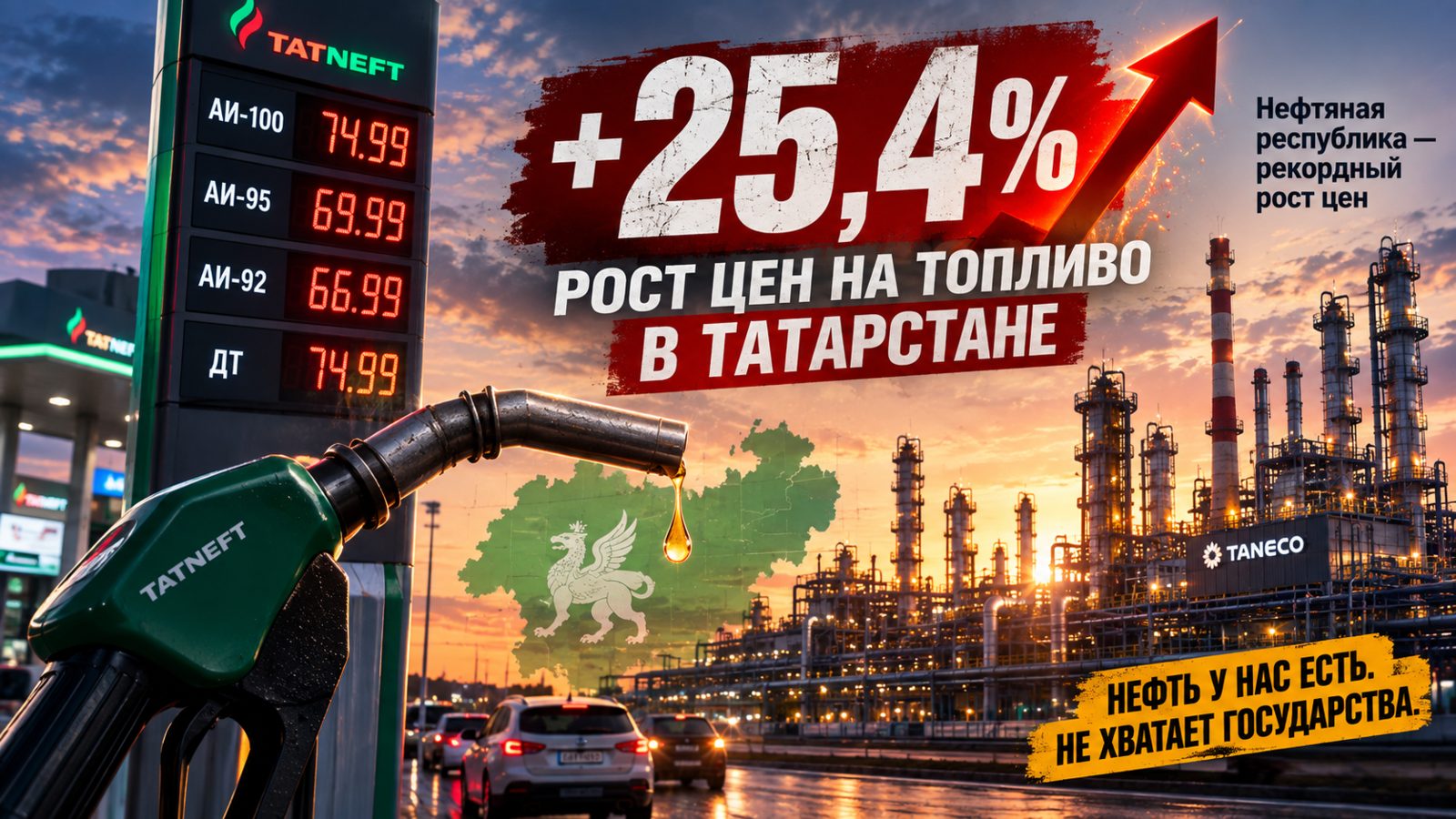
The number of the day is worth remembering: motor fuel in Tatarstan rose 25.4% over the year and 4.72% in July alone. That is the highest increase among all non-food goods and the maximum for the entire period of observation. Annual inflation in the republic is 7.3%, higher than both the Volga Federal District (6.41%) and Russia as a whole (5.98%).
The National Bank itself names the reason: lower production of petroleum products due to refinery maintenance coincided with high summer demand. The word “strikes” does not appear in the official explanation, although the Nizhnekamsk oil hub was attacked twice in August.
Let us answer the counterargument immediately
We will be told — fairly — that in absolute terms gasoline in Tatarstan is cheaper than the district and national averages. Moreover, the National Bank has directly explained why fuel here had been rising more slowly than nationwide: the republic has many stations belonging to large vertically integrated companies that can redistribute supplies and smooth prices.
We accept that — and turn it around. Tatarstan has everything most regions do not: its own oil, two refineries, Tatneft with its own filling-station network, vertical integration from the well to the pump. And with that complete set of advantages, the republic still receives its steepest fuel-price increase in fourteen years and inflation above the Russian average.
That is the point. The issue is not that Tatarstan residents pay more than everyone else. The issue is that ownership of oil gives them virtually nothing. No protection from prices, and no protection from drones.
Where exactly our authority ends
Export duties and bans — Moscow. The fuel damper mechanism and excise taxes — Moscow. The mineral extraction tax — Moscow. The decision to wage the war in which refineries burn — Moscow. The republic has not a single lever in the chain that ends with the price at its own filling station.
Meanwhile, utility charges rose 22.11% over the year, and sugar rose 7.64% in a single month. People living on oil-bearing land pay bills whose rules are set in another city.
What sovereignty changes
An independent Tatarstan would not abolish world oil prices — we make no such promises. It would change one thing: the owner of the resource would also control the income from it. Taxes from extraction and refining would form Kazan’s budget instead of passing into someone else’s military budget. Fuel policy would be written for the citizens of the republic rather than for the needs of an army fighting a thousand kilometers away.
We have had oil for a hundred years. What we still lack is a state.
Sources:
KazanFirst, August 21, 2026
Pro Kazan, August 20, 2026
Tatar-inform, July 17, 2026: National Bank of Tatarstan explanation
TNV, July 23, 2026: prices below Volga Federal District and Russian averages