
Ukraine’s Victory Is the Watershed: Why We Work with Garry Kasparov
Garry Kasparov calls Ukraine’s victory a condition for the collapse of Russia’s imperial project, while the Free Russia Forum’s Strasbourg Declaration explicitly recognizes the right of national republics and peoples to self-determination. We explain where our positions coincide, where ours goes further, and why this cooperation has continued for years.
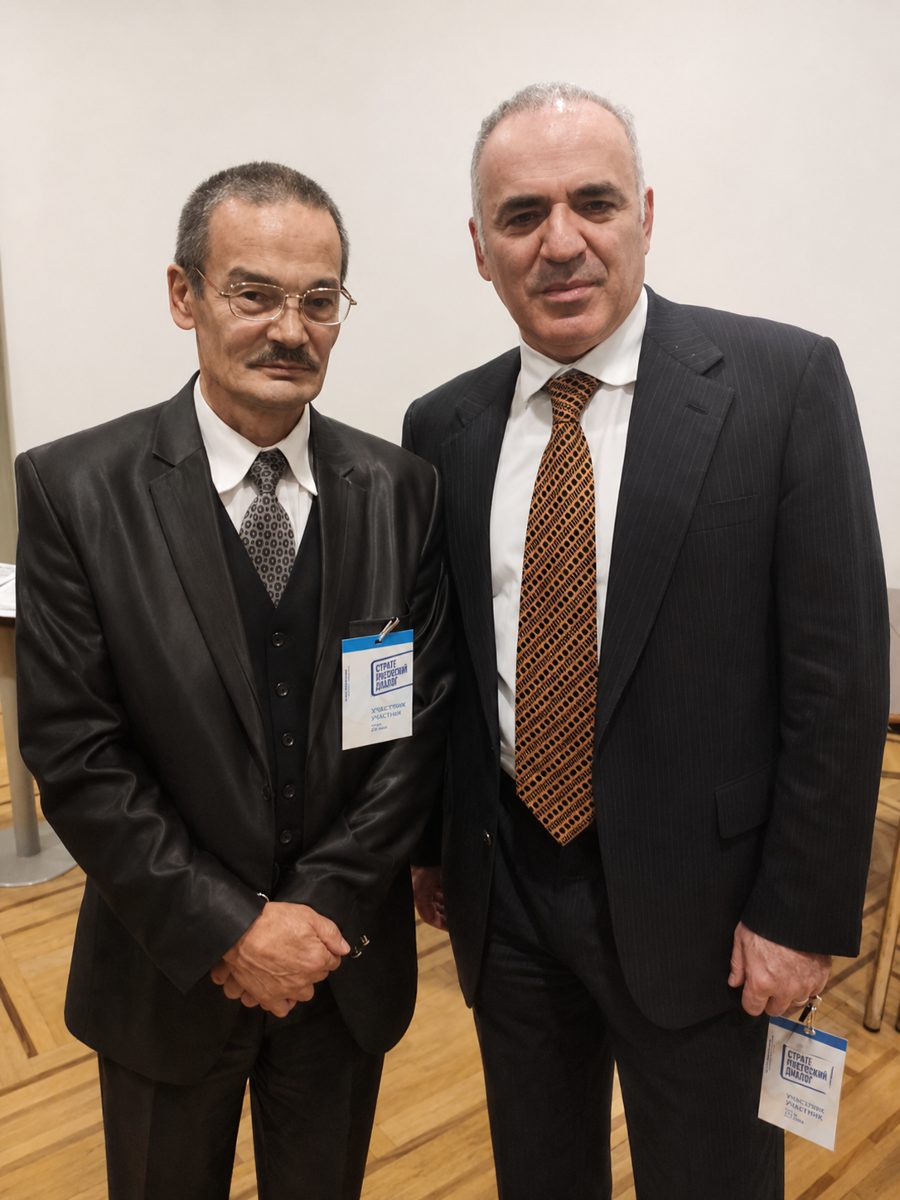
Statement by the Press Service of the Government of Independent Tatarstan in Exile
On 31 August, Garry Kasparov published a column in Echo titled “The question ‘Are you for Ukraine’s victory or not?’ is a fundamental dividing line.”
This text matters to us not because we agree with every word of it. It matters because, on the central issue, our positions have converged for years: Russia’s imperial project cannot be made safe through cosmetic reforms, and the defeat of its aggression against Ukraine is a necessary condition for dismantling that project.
That is precisely why the Government of Independent Tatarstan in Exile works with Garry Kasparov and his team.
What Kasparov is saying
The column begins with a harsh diagnosis. Kasparov describes Putin’s regime as a reincarnation of absolute evil that has absorbed the worst features of systems from Stalinism to fascism, and he rejects the familiar parallel with Nazi Germany: even under the scale of terror there, large numbers of people consciously chose resistance and paid for it with their freedom and their lives; nothing comparable exists in Russia today.
This is the basis of his criticism of part of the Russian émigré community, which, while Ukrainian cities are being bombed, continues to debate electoral technologies as though Russia were merely an ordinary authoritarian regime that could be replaced through the right set of procedures.
He also targets the concept of the “first flight” — the expectation that, once Putin falls, one will be able to return to Moscow and begin building a new country. His answer is direct: first the regime must collapse, and the public consciousness, saturated with war, must change.
But his central argument is broader:
“Real change in Russia became possible only after severe geopolitical defeats.”
Defeat, Kasparov argues, destroys the belief that Russia has the right to dictate its will to other peoples. That is why Ukraine’s victory is not merely about the outcome of a single war: it means the collapse of the imperial project. And the question “Are you for Ukraine’s victory or not?” becomes a dividing line that shows which side a person is on.
Our answer is very simple.
Yes. We are for Ukraine’s victory. Without reservations.
For Tatarstan, this is not someone else’s war
On 30 August, the 36th anniversary of the Declaration of State Sovereignty, the flags of Tatarstan, the Oirat-Kalmyk people and Buryatia flew side by side over Union Square in New York.
Kamil Sukaev, Ambassador of the Government of Independent Tatarstan in Exile in the United States, said from the square that Ukraine must be supported with weapons, funding, sanctions and diplomatic pressure because the Ukrainian front is where the question is being decided of whether the empire will retain the capacity to keep other peoples under its control.
For us, this is not an abstraction. According to the BBC Russian Service and Mediazona, by 21 August 2026 the deaths of 9,465 military personnel from Tatarstan had been confirmed by name — the second-highest absolute figure among Russia’s regions after Bashkortostan. Researchers note that the absolute totals are also affected by how actively local volunteers collect information about the dead.
But that does not change the substance: the empire is waging its war with people from our republics.
For national movements, therefore, the formula “this is not our war” is an attempt not to see the obvious. Moscow’s ability to continue the war against Ukraine is directly connected to its ability to maintain political, economic and coercive control over Tatarstan, Bashkortostan, Buryatia and the others.
Why our positions converge
As early as July 2025, Kasparov stated his position in uncompromising terms: the Russian Empire must cease to exist as a political entity, and he named the liberation of occupied territories and Russia’s military defeat as necessary conditions for that outcome.
But over the past year, a development has taken place that matters to us more than any single column.
On 20 April 2026, participants in the Free Russia Forum adopted the “Declaration of the Citizens of New Russia” in Strasbourg. Its stated goal is the transformation of imperial Russia into a modern democratic state — or into several democratic states. Point 11 states:
“National republics and peoples currently within the Russian Federation have the right to self-determination.”
This is a fundamental formulation, and we consider it important to record it separately.
It means recognizing that the future of Tatarstan, Bashkortostan, Buryatia, the peoples of the North Caucasus and others must not be determined by yet another government in Moscow — even a democratic one. Peoples themselves must decide their own fate.
This is the foundation of our cooperation with Garry Kasparov and his team. We may come from different political traditions and have different visions of the post-imperial space, but we agree on four points:
Russia in its present imperial form is dangerous both to neighboring states and to the peoples within the federation itself.
Ukraine’s victory is necessary for the destruction of the imperial project.
National republics and peoples have the right to determine their own political future.
Preparation for the end of the empire must begin today, not on the day it happens.
Where our position goes further
Agreement on principles does not mean identical goals, and we will not pretend otherwise.
For the Russian democratic opposition, the right of peoples to self-determination is one question among many in a future political reordering. For us, it is the central question and the focus of our work.
We are not working on a project for a “good Russia,” and our task is not to reform Moscow. Our political goal is an independent, democratic Tatarstan. The Declaration of 30 August 1990 proclaimed the state sovereignty of the republic, proceeding from the inalienable right of the Tatar nation and the entire people of Tatarstan to self-determination. That is the political line we continue.
At the same time, recognizing the right to self-determination does not mean that anyone outside the republic — Kasparov, the Russian opposition, European politicians, or we ourselves in exile — is entitled to decide in advance the details of Tatarstan’s future state system. The principle means the opposite: the final decision belongs to the people of Tatarstan.
Exile is not a waiting room
On one point Garry Kasparov is unquestionably right: it is pointless to sit outside the country waiting for a “first flight.”
Political exile is justified only when it creates what cannot be created inside an authoritarian state. That is why our government works on international representation, cooperation with other national movements, human-rights advocacy and the building of political relationships.
Over the past five years, approximately 350 petitions have been submitted on behalf of the government and the Tatar Public Center in support of people facing persecution; according to Prime Minister Rafis Kashapov, around ten people were removed from Interpol’s database following such appeals.
This is only a small part of the work that is necessary. But the institutions of a future state cannot be created on the day the empire suddenly weakens. By then, there must already be people, relationships, representation, documents, a program and an understanding of what to do next.
The dividing line also runs through national movements
Kasparov’s question is addressed not only to the Russian opposition. It is addressed to us as well.
Our movements, too, sometimes resort to evasive formulas: “we are against any war,” “Ukraine is not our issue,” “we deal only with our own republic.” But it is impossible to oppose the Russian Empire while remaining neutral at the moment when that empire is waging its largest war for the right to decide the fate of other peoples.
We should also say the opposite honestly: Ukraine’s victory by itself will not bring independence to Tatarstan. But Ukraine’s defeat would dramatically strengthen the empire by proving to Moscow once again that military force works and that borders, states and the will of peoples can be changed through violence.
Supporting Ukraine is therefore not only a moral position; it is also a direct strategic interest of national liberation movements.
An alliance does not require identical views
We do not believe we need to agree with Garry Kasparov on everything. Nor do we intend to become participants in the internal conflicts of the Russian opposition.
Our criterion for cooperation is different: does our counterpart recognize Ukraine’s right to defeat the aggressor, recognize the imperial nature of the present Russian state, and recognize the right of peoples and national republics to determine their own future?
On these questions, our positions with Garry Kasparov converge. That is why we have worked, and will continue to work, together where our goals coincide — while speaking openly about where they differ.
A strong alliance is not built on partners pretending to think alike. It is built on a clear understanding of why they act together.
What must be done now
The Russian Empire will not cease to exist simply because more reasonable politicians one day appear in Moscow. An empire ends when the center loses the ability to determine the fate of others by force.
That means organizations fighting for the freedom of their republics face two tasks at once. The first is to help Ukraine stop the aggression and defeat it. The second is to prepare their own peoples and institutions for the moment when a window of opportunity opens.
No one knows when that will happen. But one thing is certain: freedom rarely announces its arrival in advance. Either you are ready for it, or the historic opportunity will once again be used by others.
The Government of Independent Tatarstan in Exile has already given its answer to Garry Kasparov’s question: “Are you for Ukraine’s victory or not?”
We are for Ukraine’s victory. For dismantling the empire. And for Tatarstan’s right to determine its own future.
Press Service of the Government of Independent Tatarstan in Exile
Sources
- Garry Kasparov, Echo, 31 August 2026
- Garry Kasparov on the end of the Russian Empire, Charter 97, 14 July 2025
- “Declaration of the Citizens of New Russia” (Strasbourg Declaration), Free Russia Forum, 20 April 2026
- Declaration published by Echo
- Mediazona and BBC Russian Service casualty database
- Declaration of State Sovereignty of the Tatar SSR, 30 August 1990