
Tatarstan — a Pilot Region of Fear
In Kazan, four women who spoke out against biometrics in schools have reportedly gone out of contact. Among them are a pediatrician, a mother of many children, and a scholar. The state is silent. We are not.
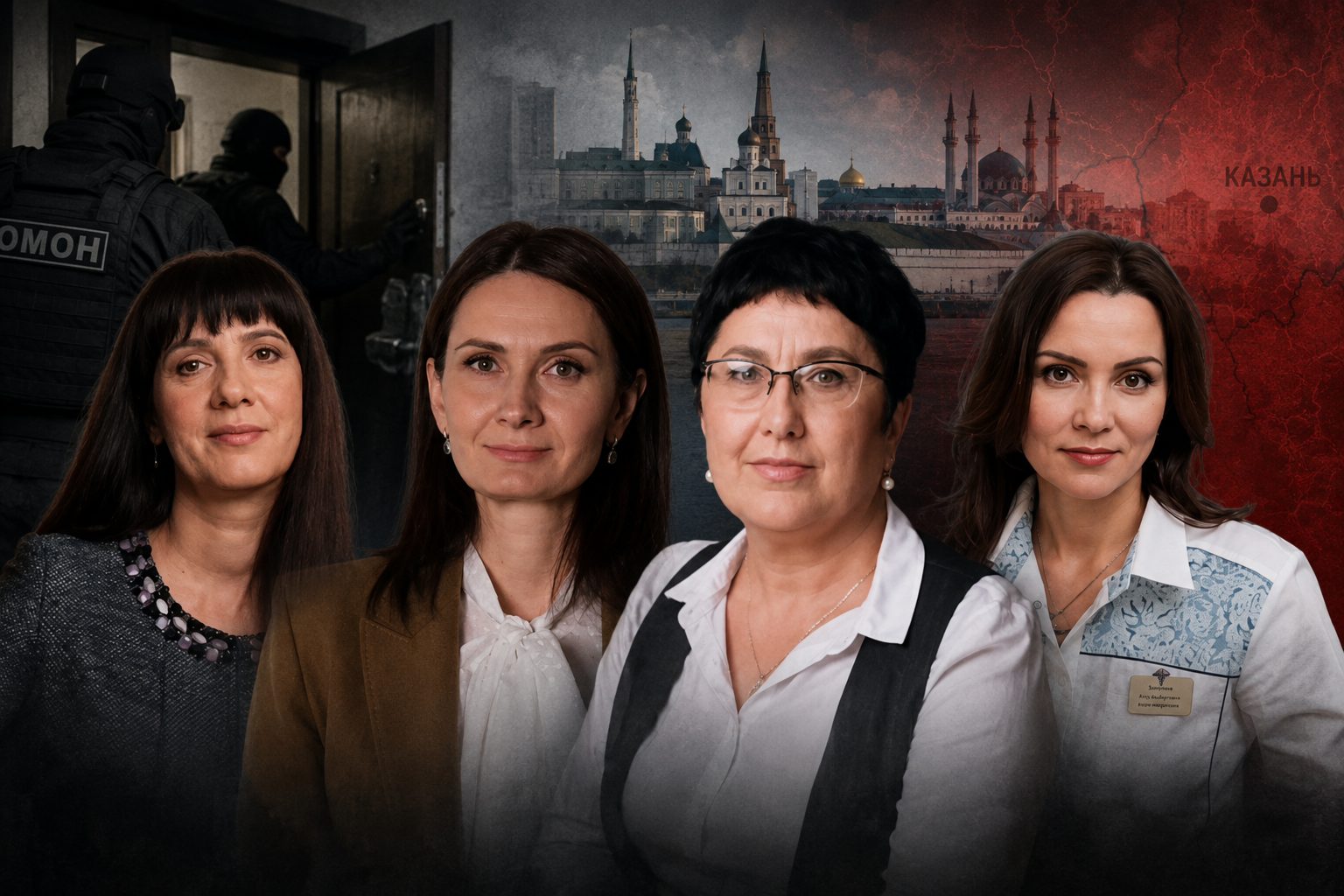
On the morning of August 18 in Kazan, Alsu Zainullina — a pediatrician and mother of many children — stopped responding. Not long before, she had taken part in a round table at the Public Chamber of Tatarstan and done what a children's doctor is supposed to do: object to the introduction of biometrics in schools. Not a leaflet. Not a rally. An official platform created by the state itself. In today's Russia, it does not get more legal than that.
That same day, activists Zulfiya Khusainova and Lilia Baranova also stopped responding. According to reports citing people close to her, officers came to search the home of candidate of sociological sciences Aida Nurutdinova, who had defended the rights of teachers and children; later, reports emerged that she had been detained and that her parents' apartment had been searched. All four women are connected with the Parents' Union and with opposition to facial-recognition systems in Tatarstan schools.
For two of the four, we currently know little beyond their names. That too is a diagnosis of the system: it removes people from ordinary life so routinely that even basic information about them has to be assembled piece by piece.
What is known, and from where
We have a duty to be precise — and we will be. At the time of publication, there is not a single official law-enforcement statement explaining the grounds, the alleged offenses, or the women's procedural status. Everything currently known comes from the independent outlet Govorit NeMoskva (citing the Telegram channel Razoblacheno) and from people close to those detained.
Remember this asymmetry. A state that demands total transparency from citizens — down to the geometry of a child's face — says nothing about its own actions. The system wants the faces of our children while hiding its own face.
The experiment is being conducted on Tatarstan's children
Kazan was selected as the first pilot region for introducing biometrics and facial recognition in schools. The experiment is being conducted on Tatarstan's children. Four women asked questions about the terms of that experiment — as parents, as a doctor, as a scholar.
One can support biometrics. One can oppose it. But a society that answers an argument with a search has already answered the main question: these technologies are being introduced not to protect children, but to protect those in power from questions.
For Aida Nurutdinova, this is not her first encounter with the system. According to OVD-Info, on March 16, 2024, she was detained in Kazan and kept overnight at Police Department No. 16, Yapeeva; published court materials describe an administrative case over a VKontakte post about a public action during the presidential election. A post. Detention. Now — reports of a search. The steps of this staircase are well known.
Answering the objection in advance
We will be told that journalists link the Parents' Union to supporters of Svetlana Lada-Rus, whose party the authorities liquidated as “extremist,” and that cases involving “justification of terrorism” have for years been brought against her supporters. Our answer is direct. The Government of Independent Tatarstan in Exile is not acting as counsel for any organization and is not required to share these women's beliefs. Human rights are not a prize for holding the correct views. If investigators have evidence of a crime, they present it to a court, to defense lawyers, and to society. When an early-morning search and silence are presented instead of evidence, that is an admission that there is nothing to present.
Trajectory: 1992 → 2026
In March 1992, the state asked the people of Tatarstan how they saw the status of their republic — and 61.4 percent of referendum participants answered “yes” to sovereignty. In August 2026, a mother who asked why a school needed her child's face is no longer reachable by evening. That is the entire path traveled in thirty-four years: from asking citizens questions — to searching citizens' homes.
Authoritarianism does not arrive in a single day. It arrives on the morning when a parent decides not to argue with an official anymore, a scholar decides not to criticize a state initiative, and a neighbor decides not to ask where the woman next door was taken. What separates a democracy from a police state is not the absence of security services, but limits on their power: an independent court, transparency, and the ability to criticize the state without listening for footsteps on the stairs.
What does Tatarstan's status have to do with this?
There will be a second objection: what does Moscow have to do with it? If searches took place, they were carried out by Kazan security officers; biometrics are being introduced by Kazan officials. That is precisely the point. The criminal provisions used for years to prosecute dissenters are federal. The practice in which parental activism is transformed into “extremism” is federal. The coercive vertical in Kazan is subordinate not to the republic, but to Moscow: an official who approved an experiment on children cannot be removed by the votes of Tatarstan's parents; a minister whose subordinates arrive at dawn cannot be summoned before a parliament accountable to the republic. The Public Chamber of Tatarstan heard the pediatrician — and could not protect her, because republican institutions in this arrangement may listen, but they cannot decide. That is what the absence of sovereignty means — not an abstraction from declarations, but the morning of August 18.
We are not declaring these women supporters of independence. We do not know their views on Tatarstan's status and have no right to speak for them. But we are obliged to name the system that makes mornings like this possible: a government accountable to another capital rather than to its own citizens will always protect itself from questions rather than protect children from risks. And it will always test the new on those it does not ask.
In a free Tatarstan, searches will not disappear — investigative measures exist in every state. Something else will disappear: searches without authorization by an independent court, detention without immediate access to a lawyer and notification of the family, a minister who does not have to answer before an elected Mejlis, and a government that cannot be replaced through elections. We have already publicly set out these principles: a ban on political repression, an independent judiciary, subordination of security structures to law and civilian oversight, and the peaceful rotation of power. And the question of whether schools need biometrics would be decided in a free Tatarstan openly — with parents at the table, not security officers at the door.
We demand
The Government of Independent Tatarstan in Exile demands that the Russian and Tatarstan authorities immediately and publicly state where Alsu Zainullina, Aida Nurutdinova, Zulfiya Khusainova and Lilia Baranova are; what their procedural status is; what actions they are accused of; on what legal basis searches and detentions were conducted, if they took place; and whether each woman has unhindered access to a lawyer and communication with her family.
The Universal Declaration of Human Rights protects against arbitrary interference with privacy, family and home and guarantees freedom of opinion and peaceful assembly. Russia remains a party to the International Covenant on Civil and Political Rights. These obligations are not suspended during searches.
We appeal to independent journalists and human-rights organizations: document every step of this case. And we appeal to the people of Tatarstan: remember these names. Pediatrician Alsu Zainullina. Sociologist Aida Nurutdinova. Zulfiya Khusainova. Lilia Baranova. If today the state believes it can refuse to answer questions about them, tomorrow it will not answer questions about you.
Until official documents appear, we do not assert that the actions of the security services were unlawful. We assert what requires no proof: the burden of explanation lies with the state. It is the state that must show that entering the homes of four women was lawful, necessary and proportionate — and not punishment for a civic position.
Dissent is not a crime. Asking about technologies applied to your children is not a crime. Motherhood and professional integrity are not aggravating circumstances.
A free Tatarstan will be a country organized in exactly the opposite way: the state will fear violating a person's rights — and the person will stop fearing the state.
Government of Independent Tatarstan in Exile
August 19, 2026