
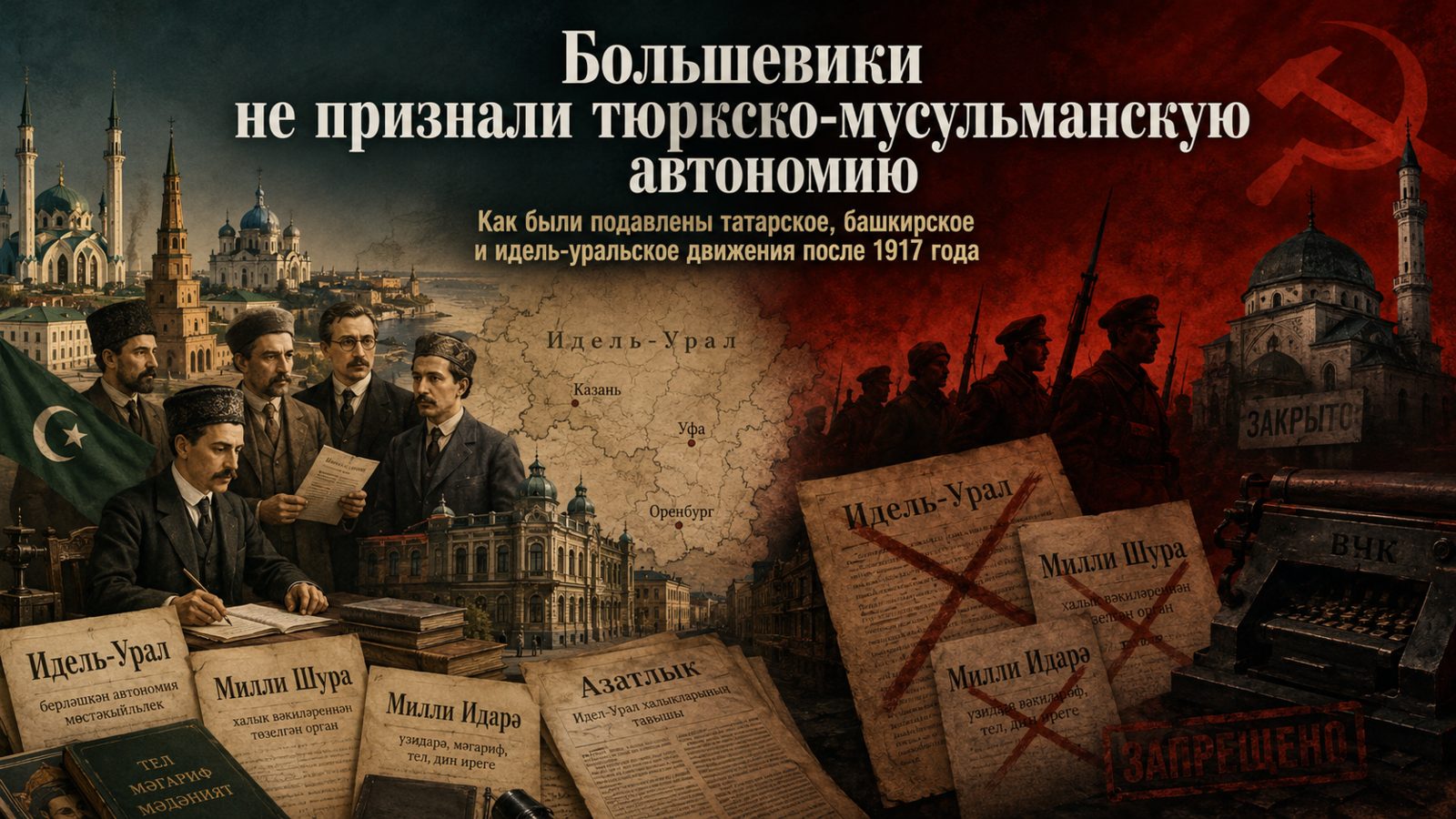
The Bolsheviks Did Not Accept Turkic-Muslim Autonomy
Raushan Gizatullin — Representative of the Government of Independent Tatarstan in Exile in Bavaria Raushan Gizatullin, Representative of the Government of Independent Tatarstan in Exile in Bavaria, commented on the policies pursued by the Bolshevik authorities…
Raushan Gizatullin — Representative of the Government of Independent Tatarstan in Exile in Bavaria
Raushan Gizatullin, Representative of the Government of Independent Tatarstan in Exile in Bavaria, commented on the policies pursued by the Bolshevik authorities toward the Tatar and Bashkir national movements following the 1917 Revolution.
According to Gizatullin, the promises of “freedom” and the “right of peoples to self-determination” proclaimed after the revolution were soon replaced by a rigidly centralized system of government.
Speaking about the events of 1917, Gizatullin said that the collapse of the Tsarist regime was regarded by the Turkic and Muslim peoples of the Volga-Ural region as a historic opportunity:
“Tatars and Bashkirs believed that centuries of oppression had come to an end. People wanted to receive education in their own languages, establish their own institutions, and freely preserve Islamic culture.”
Gizatullin noted that the principle of the “right of peoples to self-determination,” proclaimed by Bolshevik leader Vladimir Lenin, created considerable hope among the Muslim peoples of the time. He argues, however, that Moscow soon began to regard these national movements as a threat.
“The Idel-Ural Project Alarmed Moscow”
According to Gizatullin, the Idel-Ural project developed by Tatar and Bashkir intellectuals was intended to protect the political and cultural rights of Turkic-Muslim peoples.
Among the prominent figures associated with this period were Sadri Maksudi, Gayaz Iskhaki, and Zeki Velidi Togan.
Gizatullin stated:
“The Idel-Ural movement was not merely a political project. It represented an effort to preserve Turkic-Muslim identity and the desire of peoples to determine their own future. Moscow, however, viewed it as a threat to Soviet power.”
According to Gizatullin, the Milli Shura, Milli Idarä, and Muslim military formations established during this period were soon dissolved by the Red Army. He argues that the Bolshevik authorities were particularly hostile toward independent military and political institutions.
Conflict with the Bashkir Movement
Gizatullin said that the Bashkir movement led by Zeki Velidi Togan initially sought an accommodation with the Soviet authorities, but relations deteriorated sharply over time.
“At first, the Bolsheviks spoke about autonomy. But once they began interfering in the institutions of the Bashkir government, conflict became inevitable.”
In Gizatullin’s view, the Bashkir and Tatar autonomous republics established later remained “structures subordinate to Moscow without genuine independence.”
“A Wave of Mass Repression Began in the 1930s”
Gizatullin stated that from the late 1920s and throughout the 1930s, Soviet pressure on Muslim communities intensified, with large-scale purges taking place under Joseph Stalin.
“Mosques were closed, madrasas were dismantled, and religious leaders and intellectuals were targeted under accusations of ‘Pan-Turkism’ and ‘counterrevolutionary activity.’ Thousands of people were exiled or killed.”
Gizatullin emphasized that this period remains an important part of the historical memory of Tatar and Bashkir society and, in his view, is not merely an issue of the past.
“What happened after 1917 demonstrates how promises made to peoples could later be withdrawn. This is why the history of the Tatar and Bashkir national movements continues to be discussed and remains relevant today.”