
Flowers for Tukay in Moscow: Culture on Display, Less Room for the Language at School
Tatarstan Culture Days opened in Moscow with flowers laid at the monument to Gabdulla Tukay. Back in the republic, the number of schools teaching in Tatar fell from 610 in 2022 to 591 in 2024, while federal curricula reduced first-grade hours for native-language study.
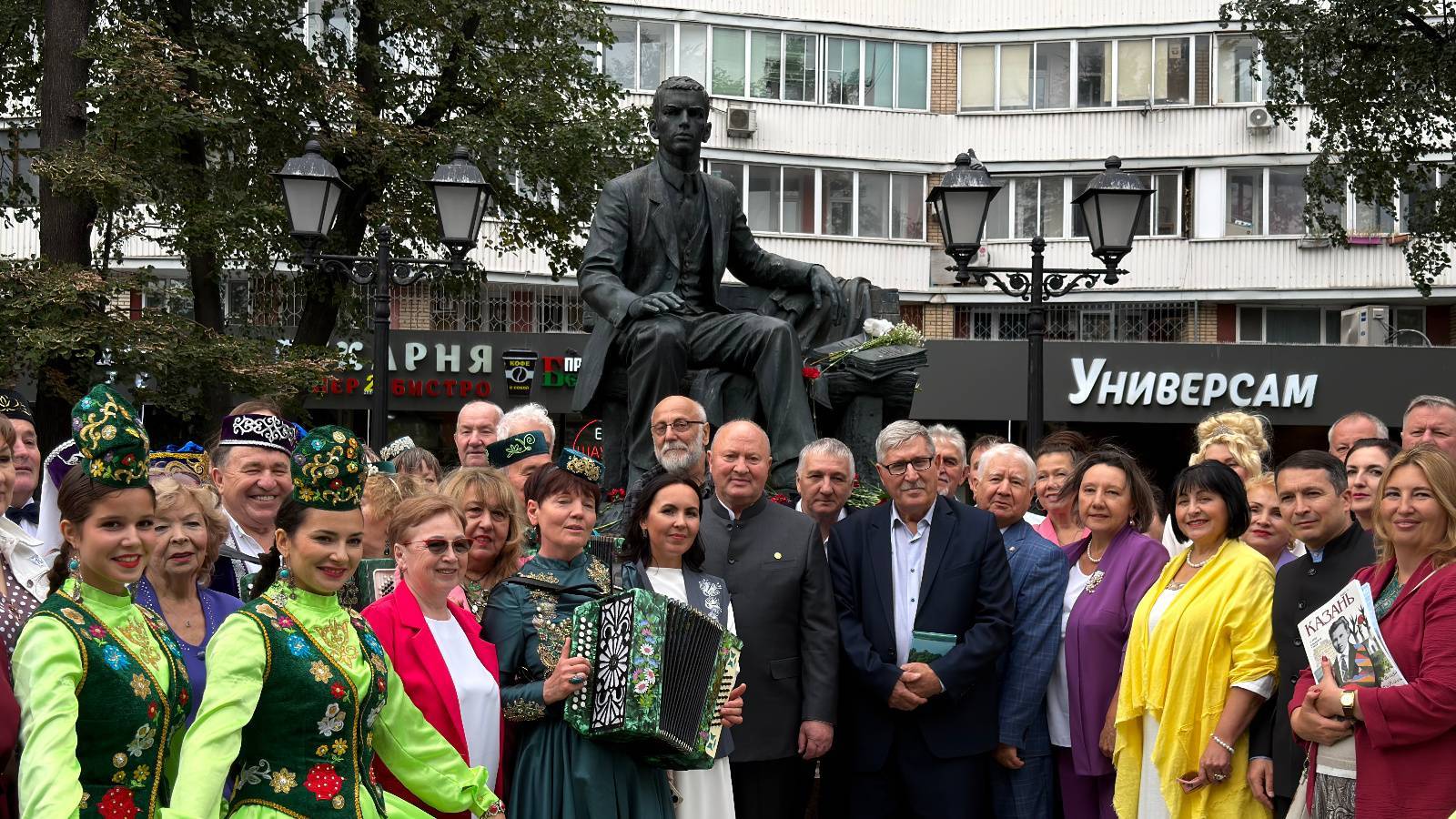
Tatarstan Culture Days opened in Moscow on August 20 with the traditional laying of flowers at the monument to Gabdulla Tukay; reports on the opening were published the following morning. The year marks the poet’s 140th anniversary and 15 years since the Moscow monument was unveiled.
The ceremony itself is not the problem. But the festive program should be read alongside another set of figures — those from Tatarstan’s schools.
The arithmetic outside the festival program
According to Tatarstan’s Education Ministry, 591 educational organizations in the republic used Tatar as a native language of instruction in the 2024/25 school year, with some subjects taught in Russian. There were 610 such schools in 2022 and 600 in 2023. Education Minister Ilsur Hadiullin said the decline was mainly caused by the closure of very small rural schools as the number of school-age children fell. That context matters: it would be misleading to attribute all 19 closures solely to federal language policy.
At the same time, federal decisions have reduced the space allocated to native languages. From September 1, 2025, first-grade instruction in native language and literary reading was reduced from two hours to one per week; in schools with a non-Russian language of instruction, from three hours to two. Tatarstan’s State Council deputies objected to the changes.
What happened to the subject’s name
An important correction is needed here. The original federal order envisaged replacing “Native Language” with “Language of a People of the Russian Federation.” After criticism from Tatarstan, the words “Native Language” were retained, while the federal wording became “Native Language (language of a people of the Russian Federation).” It is therefore inaccurate to say that the phrase “native language” disappeared completely.
The dispute is nevertheless revealing. Even the wording and number of hours available for Tatar-language education in Tatarstan are shaped by federal rules. The republic can object and appeal, but Moscow retains the final authority.
Culture permitted for display
The Russian model readily showcases national culture through concerts, monuments, costumes and festivals. The harder question is whether a language functions as an everyday institution — in schools, universities, government, courts, science and media.
Flowers for Tukay and reduced classroom time for Tatar are therefore not contradictory facts. They coexist: one represents symbolic recognition, while the other shows the practical limits of the republic’s linguistic autonomy.
What gives a language real strength
A language is not sustained by festivals alone. It needs schools, teachers, textbooks, universities, media and the ability to function fully in public life. For Tatarstan there is also a political question: who has the authority to set language policy on its territory.
Flowers were laid for Tukay in Moscow. A stronger monument in Tatarstan would be a generation of children for whom Tatar remains a full language of education and modern life.